Claim Your Free Estimate Today
Table of Contents
- Understanding Commercial Water Heater Repair Costs
- What Factors Drive Commercial Water Heater Repair Cost
- Getting an Accurate Commercial Water Heater Repair Estimate
- Commercial Water Heater Repair vs Replacement: When to Choose Each
- How Long Does Commercial Water Heater Repair Take
- Why Downtown Tucson Businesses Should Act Fast on Water Heater Problems
- Frequently Asked Questions
Last Updated: October 10, 2026
Understanding Commercial Water Heater Repair Costs
Commercial water heater repair costs depend on what’s broken, how quickly you need it fixed, and system complexity. Understanding these factors helps downtown Tucson businesses budget and make smarter decisions.
Costs vary by situation. A thermostat replacement differs dramatically from replacing a failed heat exchanger or addressing tank corrosion.
The most expensive repairs often result from delayed maintenance or emergency after-hours calls, not complexity alone.
What Factors Drive Commercial Water Heater Repair Cost
Costs break down into five categories: diagnostic fees, labor, parts, system capacity, and service timing.
Diagnostic and Service Call Fees
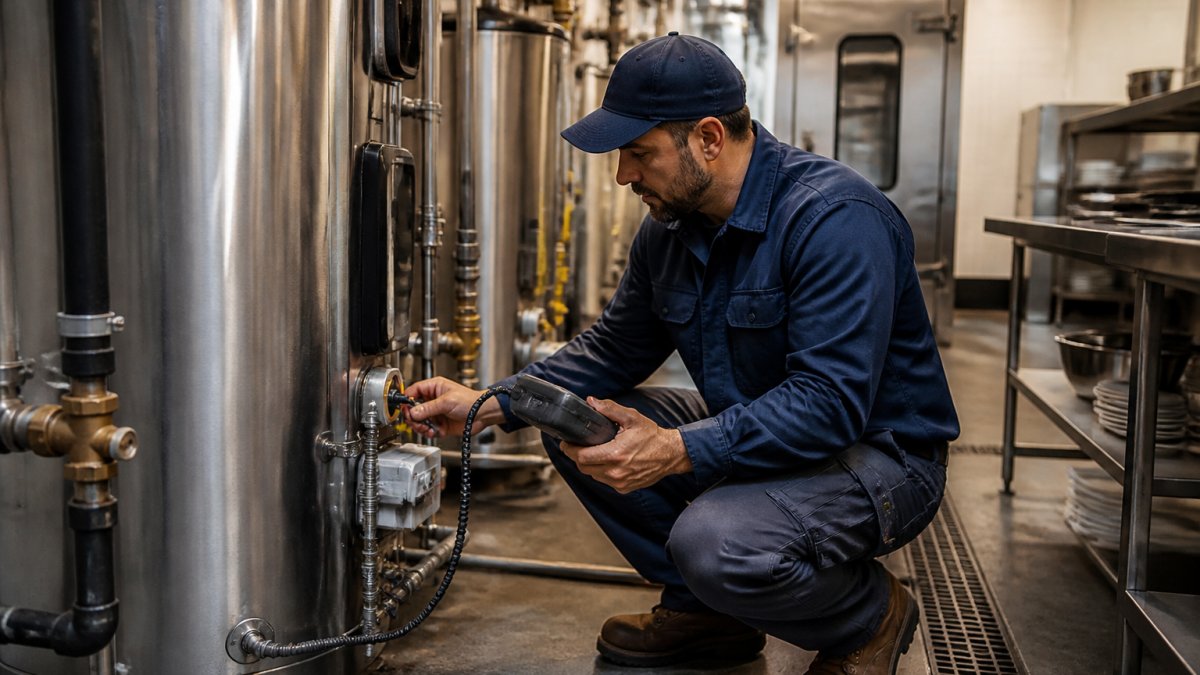
Diagnostic fees are often waived if you proceed with repair. Downtown locations require assessment of access challenges (basement, rooftop, tight mechanical rooms), which affects labor estimates.
Labor Costs by Repair Complexity
Labor is typically the largest cost. Simple repairs (thermostat, valve, heating element) require 1-2 hours.
Complex repairs (heat exchanger replacement, widespread corrosion) require 3-5 hours or multiple visits, compounding labor costs.
Emergency calls outside normal business hours incur premium rates.
Parts and Availability
Parts costs vary dramatically by component and system type. Common replacement parts fall into predictable ranges:
- Thermostats and controls:
- Pressure relief valves:
- Heating elements (electric systems):
- Dip tubes and internal components:
- Heat exchanger (tankless systems):
- Gas valve assemblies:
- Expansion tanks:
Standard parts ship quickly; specialized commercial parts may require 2-7 days. Expedited shipping or same-day sourcing adds to the cost.
System Capacity and Type
Larger systems cost more to repair. A 40-gallon electric unit is cheaper than a 120-gallon gas unit or 200-gallon hotel system.
Larger tanks require more labor and higher-cost parts. Specialized systems (tankless, heat pump, hybrid) require certified technicians.
Gas systems require venting inspection, pressure testing, and combustion analysis. Tankless systems require specialized equipment to flush or replace mineral-clogged heat exchangers.
Service Timing and Scheduling
Scheduling timing shapes costs as much as the problem itself. Proactive calls allow standard rates; emergency calls trigger premium labor, rush delivery, and higher sourcing costs.
Downtown businesses must coordinate repairs around operating hours. Restaurants and hotels may require temporary heating solutions or staggered work, extending timelines and labor costs.
Downtown Location and Access
Downtown locations add costs: tight mechanical rooms, limited parking, multi-tenant coordination, and restricted access increase labor time.
Building coordination may require advance notice and staff escort, delaying service. Rooftop or basement units requiring special equipment increase labor costs.
Putting It Together: A Cost Example
A downtown restaurant’s failed dip tube repair costs will vary. The same repair on a weekend or with expedited parts delivery will cost more due to after-hours premiums and sourcing costs.
Getting an Accurate Commercial Water Heater Repair Estimate
Request a free estimate and provide system type, age, capacity, and symptoms for accurate pricing.
In-person inspection provides accurate estimates; phone or online quotes for commercial systems are unreliable.
Request labor and parts breakdown to understand cost concentration and inform repair-versus-replacement decisions.
Request written estimates specifying work, parts, labor hours, and total cost. Clarify how additional issues discovered during repair will be handled.
Commercial Water Heater Repair vs Replacement: When to Choose Each
The repair-versus-replacement decision must account for repair cost, equipment age, failure history, downtime, and future emergency risk.
The 50% Rule and Equipment Age
The “50% rule” suggests replacement if repair cost exceeds 50% of replacement cost, but commercial systems require additional analysis.
A 100-gallon gas replacement can be a significant investment. A repair quote that is a substantial portion of the replacement cost suggests replacement by the 50% rule, but equipment age, failure pattern, and downtime tolerance matter more.
Most commercial units last 10-15 years. A 12-year-old unit with a failed heat exchanger is nearing end-of-life; a 5-year-old unit should be repaired.
Units beyond year 12 with two or more repairs in 18 months should be replaced. Replacement eliminates emergency cycles and provides 5-10 year warranty protection.
Repair Cost Relative to Replacement and Downtime
For downtown businesses, downtime cost often exceeds repair cost. A restaurant cannot operate its kitchen; a hotel loses guests and reputation; a laundry or medical office faces immediate revenue loss.
A hotel’s Friday evening failure: repair costs will vary, and replacement costs will also vary. If repair fails again within a short period, total cost may exceed replacement. Replacement eliminates peak-season failure risk.
For 24/7 operations, calculate downtime revenue loss. Significant hourly losses can make a repair cost substantial. Replacement prevents future emergencies and protects revenue.
Claim Your Free Estimate Today →
Failure Pattern and Recurring Problems
Multiple repairs in one year, especially different components, indicate system deterioration. Replacement prevents cascading failures in aging equipment.
Recurring leaks or pressure loss indicate underlying corrosion or tank failure. Repair is temporary; replacement is permanent.
Energy Efficiency and Operating Costs
Modern units are 15-25% more efficient than 10-year-old models, using improved insulation, efficient burners, and smart controls.
An older 100-gallon unit may have higher operating costs; modern replacement can offer significant savings over time.
Calculate your potential energy savings: Estimate the efficiency improvement (modern units are typically more efficient). If the total savings exceed a significant portion of replacement cost, replacement makes financial sense even if the current unit could be repaired.
Tankless and heat pump water heaters offer even greater efficiency gains but also higher upfront costs. For a downtown business with high hot-water demand, these systems can pay for themselves through energy savings.
Warranty and Peace of Mind
A new commercial water heater comes with a manufacturer’s warranty (typically 5-10 years on parts and labor). A repaired unit has no warranty; if the same component fails again within months, you pay for the repair again.
For a downtown business where downtime is costly, warranty coverage provides peace of mind. You can plan maintenance, avoid emergency calls, and budget predictably. A repaired unit offers no such assurance.
Downtown-Specific Factors: Access, Scheduling, and Business Continuity
Downtown Tucson businesses face unique constraints that favor replacement in some cases:
Access and Installation: Downtown buildings often have limited mechanical space, rooftop access, or multi-tenant coordination requirements. Replacement may require temporary water heating solutions or staggered installation across multiple shifts, increasing downtime. If your building’s constraints make replacement especially disruptive, repair might be the pragmatic choice despite higher long-term risk.
Scheduling Flexibility: A repair can often be scheduled around business hours. Replacement requires a full day or more of access and coordination. If your business cannot afford a full-day shutdown, repair buys time to plan a replacement during a slower season.
Emergency Risk: Downtown businesses with high visibility (hotels, restaurants, medical offices) face reputational risk from service disruptions. A repair that fails again within weeks creates a second emergency and damages customer trust. Replacement eliminates this risk and protects your reputation.
Decision Framework: Repair or Replace?
Use this framework to guide your decision:
Choose Repair if:
- Unit is less than 8 years old
- Repair cost is less than 40% of replacement cost
- This is the first failure or failures are infrequent (one in 3+ years)
- The failed component is a common, easily replaced part (valve, thermostat, heating element)
- Your business can tolerate a 1-2 day repair window
Choose Replacement if:
- Unit is 12+ years old
- Repair cost exceeds 50% of replacement cost
- The unit has failed twice or more in the past 18 months
- The failed component is a major part (heat exchanger, tank corrosion, gas valve assembly)
- Your business cannot afford downtime or repeated emergency calls
- Energy efficiency gains would offset replacement cost within 7-10 years
- You need warranty protection and predictable maintenance costs
Consult Your Technician: A reputable service provider will give you honest guidance. Ask directly: “If this were your business, would you repair or replace?” A technician who always recommends replacement is sales-focused; one who always recommends repair may be avoiding difficult conversations. The best technicians explain the trade-offs and let you decide based on your business’s priorities.
How Long Does Commercial Water Heater Repair Take
Repair duration varies widely. A simple component replacement, thermostat, valve, heating element, takes 1-3 hours. The technician arrives, diagnoses, swaps the part, tests the system, and leaves.
More complex repairs stretch longer. Heat exchanger failures in tankless systems or major corrosion issues in tanks require longer diagnostic time, possible parts ordering, and multiple service visits. A repair that requires ordering specialized parts might take 3-7 days from initial call to completion.
Emergency repairs during business hours often take longer because technicians coordinate around your operating schedule. A restaurant can’t shut down for a full day; the technician works around service times, which extends the overall timeline.
Diagnostic time affects total duration. If the failure point isn’t immediately obvious, the technician spends additional hours testing components, reviewing system history, and confirming the problem before beginning repair. This diagnostic work is necessary but adds to labor costs and timeline.
Why Downtown Tucson Businesses Should Act Fast on Water Heater Problems
Delay amplifies costs. A small leak detected early might require a simple seal replacement. The same leak ignored for weeks can corrode surrounding components, requiring multiple parts replacement and extended downtime.
Corrosion accelerates in commercial environments. Hard water, mineral-heavy supply, or aggressive chemical use in some facilities speeds deterioration (Corrosivity). A unit showing early signs of corrosion needs immediate attention before the problem spreads.
Emergency repairs cost more than scheduled repairs. The longer you delay addressing a developing problem, the higher the likelihood it becomes an emergency. A failing thermostat that could be repaired Tuesday morning becomes an urgent 2 AM call if you wait until Saturday.
Downtown Tucson’s heat and water quality create specific pressures. High temperatures stress cooling systems in water heaters. Mineral-heavy local water builds sediment faster than in other regions. These factors mean commercial water heater repair problems progress quickly.
Downtime impacts revenue directly. A restaurant, hotel, laundry facility, or medical office without reliable hot water loses customers and reputation. Addressing repair needs promptly minimizes operational disruption and protects your business continuity.
Commercial water heater repair costs depend on your system type, the specific components that failed, and how quickly you need resolution. At Acclaimed Drain And Plumbing Solutions, LLC, we provide upfront flat-rate pricing and free estimates so you understand costs before work begins. Our 24/7 emergency service and fast response times mean your downtown Tucson business gets back to normal operation quickly. Claim Your Free Estimate Today and let our licensed technicians diagnose your water heater problem with the professional equipment and expertise your commercial system deserves.
| Factor | Impact on Repair Cost | Timeline Effect |
|---|---|---|
| System type (gas, electric, tankless) | High, determines parts and expertise required | Varies by complexity |
| Unit capacity (40-gal vs. 150-gal) | High, larger systems cost more to service | Longer labor hours |
| Component failure (valve vs. heat exchanger) | High, some parts cost significantly more | Depends on part availability |
| Service timing (scheduled vs. emergency) | High, emergency premium can double costs | Immediate response |
| System age (5 years vs. 12 years) | Medium, influences repair vs. replacement decision | Affects long-term value |
| Downtown location access | Medium, tight spaces may increase labor time | Adds coordination complexity |
Frequently Asked Questions
What factors affect the cost of commercial water heater repair?
Commercial water heater repair costs depend on system type (tank vs. tankless), unit capacity in gallons or GPM, the specific parts that need replacement, labor time required for diagnosis and repair, and whether the repair is emergency or scheduled service. Hard water and mineral buildup can increase complexity. A professional inspection with diagnostic equipment helps identify all issues and provides an accurate estimate before work begins.
Is it cheaper to repair or replace a commercial water heater?
That depends on the unit’s age, warranty status, and repair scope. For newer systems with isolated failures, repair often costs less. Older units with declining efficiency, repeated breakdowns, or multiple failing components may cost more to repair repeatedly than replacement. A qualified plumber can calculate the break-even point by comparing repair cost against replacement cost and expected lifespan remaining.
How long does a commercial water heater repair typically take?
Repair time ranges from 1-4 hours for straightforward fixes like thermostat or valve replacement. Complex repairs involving sediment removal, heat exchanger issues, or component rebuilding may take 4-8 hours or require a return visit. Emergency repairs outside business hours may be prioritized for faster response. The plumber’s initial inspection determines actual timeline and communicates realistic completion expectations.
What should a commercial water heater repair estimate include?
A complete estimate should list the diagnostic fee (if charged separately), specific parts needed with quantities, labor hours at the stated rate, any service call charges, warranty coverage on parts and labor, timeline for completion, and payment terms. The estimate should detail what the repair addresses and what it does not.